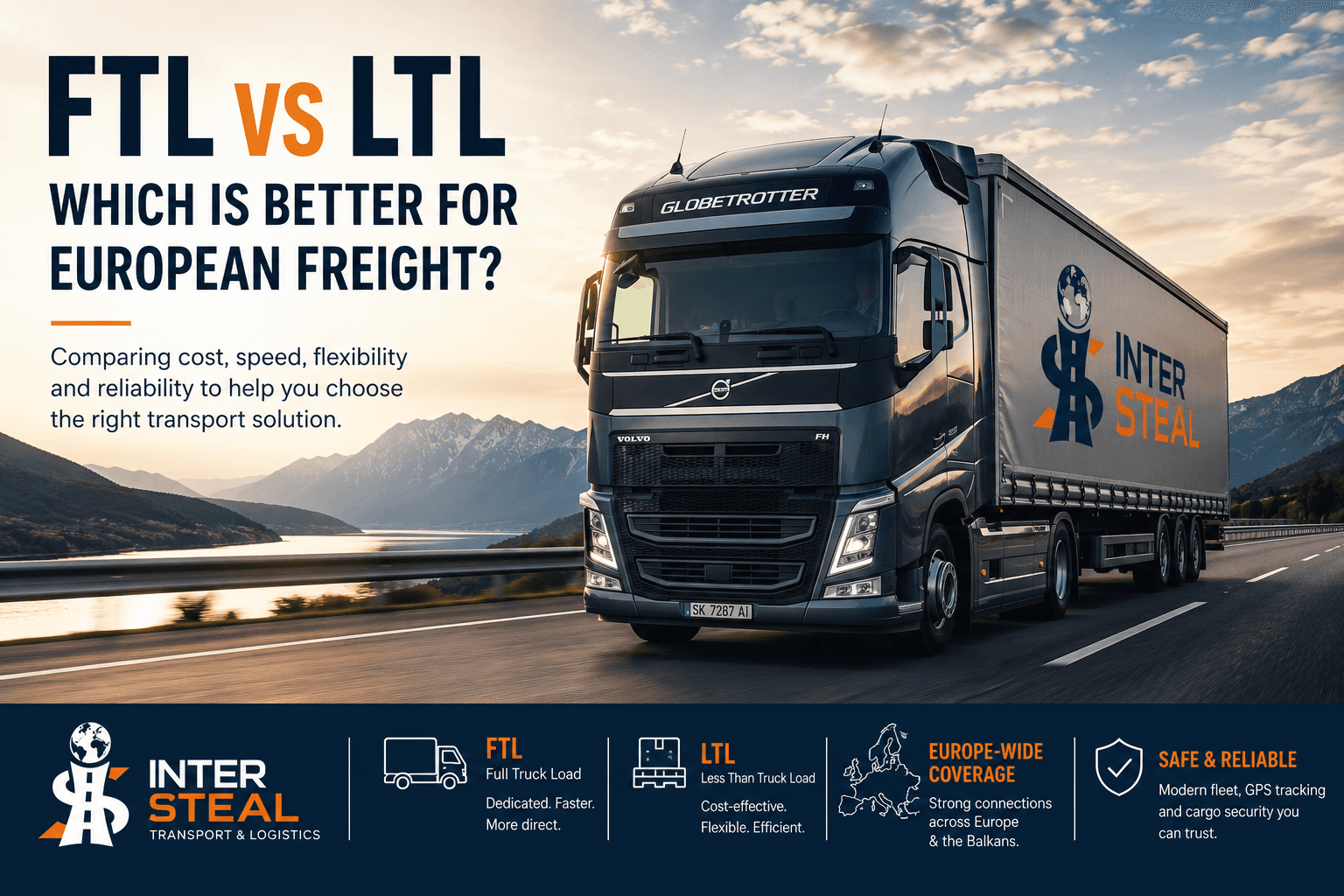
FTL vs LTL Transport: Which Is Better for European Freight?
Cost Savings
When shipping goods across Europe, one of the first decisions businesses need to make is whether to use FTL (Full Truck Load) or LTL (Less Than Truck Load) transport.
Both options are widely used in European road freight, but the right choice depends on the size of your shipment, delivery requirements, route, cargo type and budget.
At Inter Steal, we organize international road transport throughout Europe, with frequent routes connecting France, Italy, Spain, Portugal, the Balkans and other European markets.
In this guide, we explain the difference between FTL and LTL transport and help you determine which option is better for your European freight.
What Is FTL Transport?
FTL (Full Truck Load) means that an entire truck or trailer is dedicated to one customer's shipment.
The vehicle normally travels directly from the loading location to the delivery destination without consolidating goods from multiple customers.
FTL is commonly used for:
Large-volume shipments
Full or nearly full trailer loads
Time-sensitive deliveries
Temperature-controlled cargo
High-value goods
Sensitive or fragile cargo
Regular international transport routes
Because the trailer is dedicated to one shipment, FTL transport generally provides greater control over the transport process.
What Is LTL Transport?
LTL (Less Than Truck Load) allows businesses to transport smaller quantities of goods without paying for an entire trailer.
Multiple shipments from different customers can be consolidated into the same vehicle, with each customer paying for the capacity their cargo requires.
LTL can be particularly useful for:
Small and medium-sized shipments
Several pallets rather than a complete trailer
Businesses with frequent smaller orders
Shipments where delivery time is more flexible
Companies looking to optimize transportation costs
For smaller shipments, LTL can provide a more economical alternative to booking an entire vehicle.
FTL vs LTL Transport: What's the Difference?
The main difference between FTL and LTL freight is how the capacity of the truck is used.
With FTL, one customer has the entire vehicle.
With LTL, the available capacity is shared between several shipments.
This creates several practical differences.
FTL Transport | LTL Transport | |
|---|---|---|
Trailer capacity | Dedicated to one customer | Shared between customers |
Shipment size | Medium to large | Small to medium |
Transit time | Usually faster | May require additional stops |
Handling | Minimal | Potentially more handling |
Flexibility | High | Depends on consolidation network |
Cost efficiency | Best for larger shipments | Best for smaller shipments |
Temperature-controlled cargo | Excellent option | Depends on requirements |
High-value cargo | Greater control | Depends on cargo and service |
When Should You Choose FTL?
FTL is generally the better option when your shipment occupies a significant portion of the trailer or when speed, security and control are priorities.
1. You Have a Large Shipment
If you have enough pallets or cargo to fill most of a trailer, booking the complete vehicle will often make more operational and financial sense.
2. Delivery Time Is Important
FTL vehicles can normally travel directly between loading and unloading locations.
For example, a truck transporting goods from France to North Macedonia can proceed toward the destination without needing to unload or consolidate additional customer shipments along the way.
3. Your Cargo Requires Temperature Control
Products requiring controlled temperatures often benefit from dedicated transport.
Inter Ste-Al operates temperature-controlled trailers suitable for chilled and temperature-sensitive products.
Our temperature-controlled equipment also includes double-deck trailers capable of transporting up to 66 Euro pallets, depending on the characteristics and configuration of the cargo.
4. You're Transporting High-Value Goods
Dedicated vehicles can reduce unnecessary cargo handling and provide greater control over the shipment.
For higher-value cargo, Inter Ste-Al also operates trailers equipped with safety-lock systems, providing an additional layer of security during international transport.
5. You Have Regular European Shipments
Companies moving goods regularly between factories, warehouses and distribution centers can benefit significantly from establishing regular FTL routes with a transport partner.
When Should You Choose LTL?
LTL is generally more suitable when you don't have enough cargo to justify booking an entire truck.
For example, if you need to transport several pallets from Italy to the Balkans, paying for an entire trailer may not be the most economical solution.
By consolidating the shipment with other compatible freight travelling in the same direction, transportation capacity can be used more efficiently.
However, businesses should consider that consolidated transport can involve additional collection points, delivery points or handling compared with dedicated FTL transport.
Is FTL Faster Than LTL?
In most cases, FTL transport is faster than LTL transport.
A dedicated truck can typically travel directly between the shipper and consignee.
LTL transport may involve consolidation, intermediate terminals, additional loading locations or multiple delivery points.
The actual transit time depends on factors including:
Distance
Route
Border crossings
Driver regulations
Customs procedures
Ferry schedules
Loading and unloading times
Traffic and road conditions
For urgent European shipments, dedicated FTL transport is therefore often the preferred solution.
Is FTL or LTL Cheaper?
It depends on the shipment.
For a small number of pallets, LTL is usually more cost-effective because you only purchase part of the available transport capacity.
As shipment volume increases, however, FTL can become increasingly competitive.
The actual freight price depends on much more than shipment size. European road freight rates can also be affected by route availability, fuel prices, tolls, seasonality, equipment requirements, loading dates and available return capacity.
For this reason, comparing an actual FTL and LTL quotation is often the best way to determine the most economical option.
FTL and LTL Transport Across Europe
European supply chains depend heavily on international road freight to connect manufacturers, warehouses, distributors and retailers across different countries.
Inter Ste-Al provides international road transport throughout Europe, with particularly frequent operations to and from:
France
Italy
Spain
Portugal
North Macedonia
Serbia and the wider Balkans
Ukraine
We can also organize transport to and from other European countries according to our clients' requirements.
Our transport capabilities include regular tautliner transport, temperature-controlled transport, double-deck refrigerated capacity and solutions for higher-value cargo.
FTL vs LTL: Which Should Your Business Choose?
There is no single answer that applies to every shipment.
Choose FTL transport when you have larger volumes, require faster delivery, need dedicated capacity or are transporting sensitive, temperature-controlled or higher-value goods.
Choose LTL transport when you have smaller volumes and want to reduce transportation costs by sharing vehicle capacity with other compatible shipments.
For companies shipping regularly throughout Europe, the most efficient solution may involve using both FTL and LTL depending on individual shipment requirements.
Find the Right European Freight Solution
Choosing between FTL and LTL can have a significant impact on transportation costs, transit times and supply-chain efficiency.
With decades of experience in European road transport, Inter Ste-Al helps businesses find transport solutions based on their cargo, destination, schedule and operational requirements.
Whether you require a dedicated full truck, temperature-controlled transport, regular European routes or a solution for an individual shipment, our team can help determine the most suitable option.
Need to transport goods across Europe? Contact Inter Ste-Al and request a freight quotation for your next shipment.